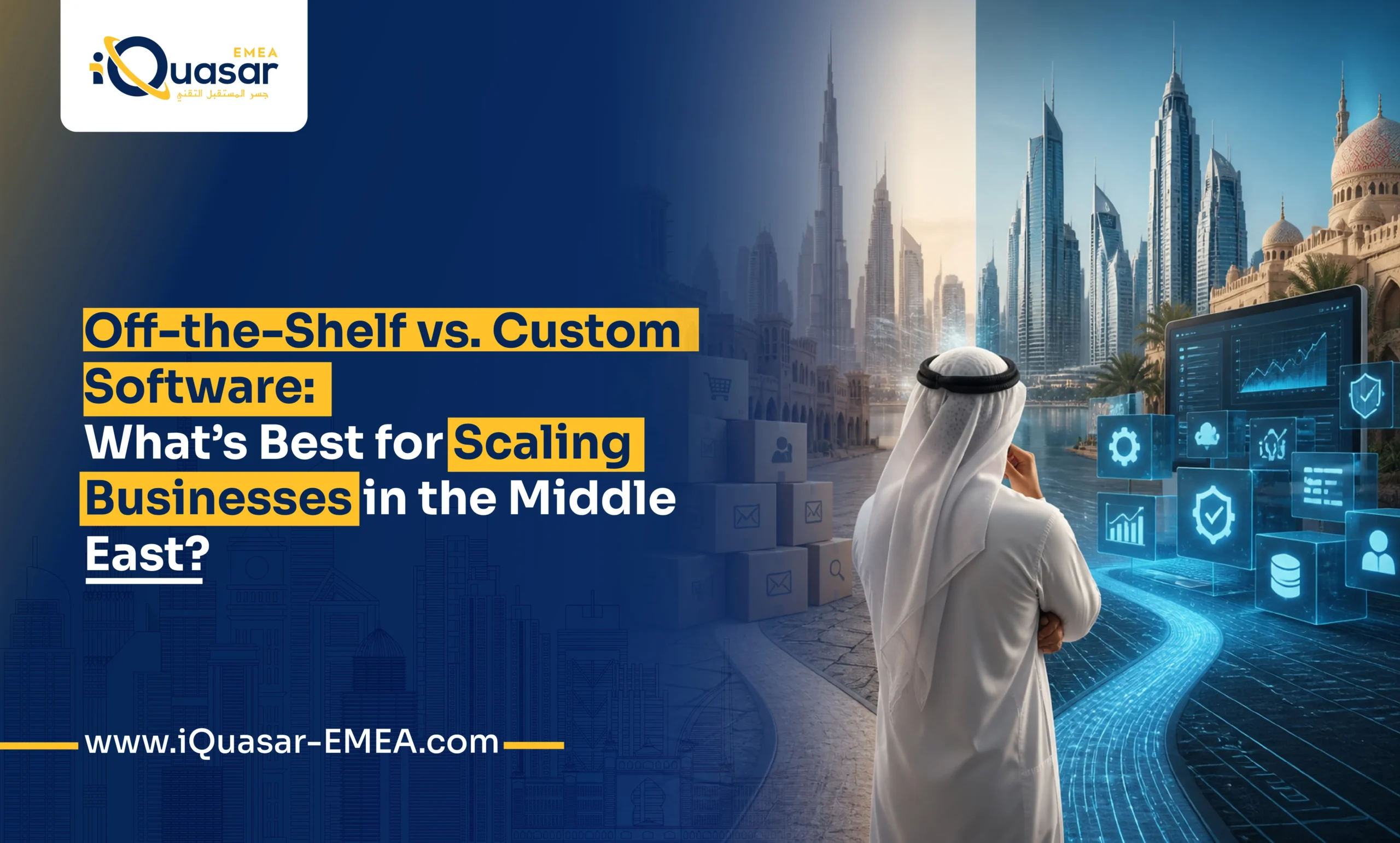
Off-the-Shelf vs. Custom Software: What Custom Enterprise Software in the UAE Means for Scaling Middle East Businesses
Every growing business in the Gulf hits the same fork in the road. You need software to run operations, and you have two ways to get it: buy a ready-made product off the shelf, or build something tailored to how your business actually works. On paper, the off-the-shelf route looks faster and cheaper. In practice, the decision shapes how far and how fast you can scale.
This matters more in the UAE than almost anywhere else right now. The UAE digital transformation market is projected to grow from USD 1.82 billion in 2026 to USD 3.75 billion by 2031, a compound annual growth rate of more than 15%. The country’s enterprise software market alone is on track to reach roughly USD 7.5 billion by 2030. Translation: the businesses around you are upgrading their technology aggressively, and the software decisions you make today determine whether you keep pace or fall behind.
So let’s break down the off-the-shelf vs. custom software question properly and explain what custom enterprise software in the UAE specifically means for companies trying to scale across the Middle East.
Custom enterprise software UAE
What Is Off-the-Shelf Software?
Off-the-shelf software is a ready-made product built for a broad market and sold to many customers at once. Think popular CRMs, accounting suites, project management tools, and standard ERP packages. You subscribe, you log in, and you start using it within days.
Where off-the-shelf works well:
- Speed: You can be operational almost immediately; no build phase, no waiting.
- Lower upfront cost: You pay a subscription rather than funding development from scratch.
- Proven and supported: The product is battle-tested by thousands of users, with regular updates and documentation.
- Good for standard processes: If your workflows are common and non-differentiating (basic invoicing, email, file storage), there’s no reason to reinvent them.
Where it starts to hurt as you scale:
- You adapt your business to the software, not the other way around.
- Per-user and per-feature pricing compounds quickly as your team grows.
- Deep customization is limited or expensive, and you’re at the mercy of the vendor’s roadmap.
- Your competitors use the same tools, so the software gives you no real edge.
What Is Custom Enterprise Software?
Custom enterprise software is built specifically around your organization’s workflows, data, and goals. Instead of bending your processes to fit a generic product, the system is designed to mirror exactly how your business operates and to connect cleanly with the other tools you already run. The global appetite for this approach is significant: the custom software development market was valued at over USD 43 billion in 2024 and continues to expand as more organizations treat technology as a growth lever rather than a cost line.
What custom software gives a scaling business:
- Exact fit: Only the features you need, built around your real processes; no bloat, no workarounds.
- Scalability on your terms: The architecture scales with your headcount, transaction volume, and market expansion, rather than forcing you into a vendor’s pricing tier.
- Seamless integration: Custom builds and API development let your systems, ERP, CRM, finance, and logistics talk to each other instead of living in silos.
- Competitive advantage: When your process is your differentiator, embedding it in software that your competitors can’t buy is a genuine moat.
- Lower long-term cost: No recurring per-seat licensing on an expanding team. For mid-market companies, the total-cost-of-ownership crossover typically lands around year three, after which custom is often cheaper to run.
The trade-off is honest: custom software has a higher upfront investment and a longer initial timeline (often a few weeks to several months, depending on complexity). It’s a strategic investment, not an instant fix.
Off-the-Shelf vs. Custom Software: Side-by-Side Comparison
Here’s how the two approaches stack up across the factors that matter most when you’re scaling:
| Factor | Off-the-Shelf Software | Custom Enterprise Software |
|---|---|---|
| Time to deploy | Days to weeks | Weeks to months |
| Upfront cost | Low (subscription) | Higher (development) |
| Long-term cost | Rises with users/features | Lower after ~year 3 (no per-seat fees) |
| Fit to workflows | You adapt to the tool | The tool is built around you |
| Scalability | Capped by vendor tiers & pricing | Grows with your business |
| Integration | Limited/third-party dependent | Native, via custom APIs |
| Compliance control | Vendor-defined | Built to your exact requirements |
| Data residency | Often outside the UAE | You choose where data lives |
| Competitive edge | None (everyone has it) | High (your process is the product) |
| Best for | Standard, non-core functions | Core, differentiating operations at scale |
Why the UAE and Middle East Context Changes the Calculation
This is where a generic “custom vs. off-the-shelf” article falls short. In the UAE, the decision isn’t just about features and price; it’s about compliance, sovereignty, and alignment with a national digital agenda.
- Data residency and sovereign cloud: Many off-the-shelf platforms store data on servers outside the region by default. For regulated sectors, finance, healthcare, and government, that’s a problem. Custom software lets you decide exactly where data lives and how it’s protected. (We cover this in depth in our guide to UAE data residency and sovereign cloud.)
- Tax and e-invoicing compliance: With UAE corporate tax now in force and the rollout of mandatory e-invoicing, your systems need to be compliant by design rather than retrofitted at the last minute. Off-the-shelf tools built for other markets often lag in local requirements. See our UAE e-invoicing Phase 2 compliance guide for what’s coming.
- Arabic and bilingual operations: True right-to-left support, Arabic-first interfaces, and localized reporting are often afterthoughts in global products but can be built in from the start with a custom solution.
- Alignment with national strategy: Initiatives like Smart Dubai and the UAE’s paperless and AI agendas reward businesses whose systems are agile, integrated, and data-driven. Custom software makes that alignment far easier to achieve.
- SMEs are the fastest movers: Notably, SMEs are the fastest-growing segment of the UAE digital transformation market, expanding at over 24% through 2031. Smaller, ambitious businesses are precisely the ones using tailored technology to punch above their weight.
When Should You Choose Each?
Choose off-the-shelf when:
- The function is standard and non-differentiating (email, basic accounting, document storage).
- You need something running this week.
- Your budget is tight, and the process doesn’t define your competitive position.
- You’re validating an idea and don’t yet know your long-term requirements.
Choose custom enterprise software when:
- The process is core to how you win business.
- You’ve outgrown spreadsheets and SaaS workarounds.
- You need deep integration across multiple systems.
- Compliance, data residency, or security demand control you can’t get off the shelf.
- You’re scaling, and per-user licensing is becoming a tax on your growth.
The Smart Middle Ground: A Phased, Hybrid Approach
The strongest answer for most scaling businesses isn’t “all custom” or “all off-the-shelf”; it’s a deliberate blend. Keep off-the-shelf tools for commodity functions. Invest in custom development for the operations that differentiate you. Then use custom integration and API development to stitch everything into one connected ecosystem.
Many enterprises start with off-the-shelf to validate a need, then transition core workflows to custom as they scale, and their requirements sharpen. Done well, this gives you speed early and control later, without paying for either prematurely.
How Custom Software Powers Real Scaling
Scaling isn’t just about adding customers; it’s about adding them without adding proportional friction, cost, and manual work. Custom enterprise software supports this by:
- Automating the workflows that would otherwise need more headcount.
- Eliminating the integration gaps where data gets re-keyed, lost, or delayed.
- Giving leadership real-time, unified data instead of fragmented reports from disconnected tools.
- Removing the per-seat ceiling that makes off-the-shelf platforms more expensive the more you grow.
- Building compliance and security from day one, so expansion doesn’t trigger a scramble.
That’s the real meaning of custom enterprise software in the UAE: technology that grows with your ambition instead of capping it.
Ready to Build Software That Scales With You?
If your business has outgrown generic tools or you’re weighing the off-the-shelf vs. custom decision for a major investment, the right partner makes all the difference. At iQuasar EMEA, we design custom enterprise software, integrations, and APIs built for UAE regulations, regional realities, and long-term scale, backed by decades of global delivery experience.
Explore our Custom Software Integration & API Development Services to see how we help Middle East businesses scale securely.
Prefer to talk it through? Set up a meeting with our team, and we’ll help you map the right path.
Frequently Asked Questions (FAQ)
- What is the difference between off-the-shelf and custom software?
Off-the-shelf software is a ready-made product sold to many businesses at once, so you adapt your processes to fit it. Custom software is built specifically around your organization’s workflows, data, and goals, so the tool fits your business instead. Off-the-shelf is faster and cheaper upfront; custom offers better scalability, integration, and long-term value. - Is custom enterprise software worth it for a UAE business?
For businesses scaling in the UAE, custom software is often worth it, especially where data residency, corporate tax, and e-invoicing compliance, Arabic localization, or deep system integration matter. While the upfront cost is higher, the total cost of ownership typically becomes lower than off-the-shelf around year three, and the software gives you a genuine competitive edge. - Is custom software more expensive than off-the-shelf?
It costs more to build initially, but it can cost less over time. Off-the-shelf software carries recurring per-user and per-feature fees that compound as your team grows, plus customization and add-on costs. Custom software removes those recurring license fees, so for a scaling business, the long-term economics often favor custom. - How long does it take to build custom enterprise software?
It depends on complexity, anywhere from a few weeks for a focused tool to several months for a full enterprise platform. A phased approach (building the highest-impact workflows first) lets you start seeing value early rather than waiting for everything to be complete. - Can custom software integrate with the off-the-shelf tools I already use?
Yes. Through custom API development and integration work, custom software can connect your existing CRM, ERP, finance, and logistics tools into one unified ecosystem, so you keep what works and add tailored capability where it counts. - Why does data residency matter when choosing software in the UAE?
Many off-the-shelf platforms store data on servers outside the region by default, which can create compliance issues for regulated industries. Custom software lets you control exactly where your data is stored and how it’s secured, which is increasingly important under UAE data protection and sovereign cloud expectations. - What’s the best approach for a growing Middle East business?
For most scaling businesses, a hybrid approach works best: use off-the-shelf tools for standard, non-core functions, and invest in custom software for the operations that differentiate you, then integrate everything into one connected system.