Demystifying Data Residency in the UAE: Why Sovereign Cloud is the Future
In February 2026, the Central Bank of the UAE launched the world’s first sovereign financial cloud services infrastructure. Months earlier, the UAE Sovereign Launchpad, backed by the UAE Cybersecurity Council, AWS, and e& began its nationwide rollout across regulated sectors. These moves signal a fundamental shift: data residency compliance is now a boardroom-level strategic imperative, and sovereign cloud has emerged as the architecture that reconciles regulation with performance.
What Is Data Residency and Why Does It Matter in the Middle East?
Data residency requires that data, particularly personal, financial, or government-classified information, be stored and processed within a specific geographic jurisdiction. For Middle East governments accelerating digital transformation through initiatives like the UAE’s Digital Government Strategy 2025 and Abu Dhabi’s ambition to become the world’s first AI-native government by 2027, data custody is inseparable from national strategy.
For enterprises, the implications are direct. Organizations that store regulated data outside approved jurisdictions face enforcement action, loss of government contracts, and erosion of client trust. Data residency determines which cloud providers you can use, how you architect environments, and whether you qualify for public-sector tenders. The regulatory trajectory across the GCC is toward tighter localization.
What Are the Key Data Localization Laws in the UAE?
The UAE’s Personal Data Protection Law (PDPL), enacted under Federal Decree-Law No. 45 of 2021, is the country’s first comprehensive federal data protection legislation. Effective since January 2022, it governs how organizations operating in the UAE mainland collect, process, and transfer personal data. Cross-border transfers are permitted only when the receiving country provides adequate protection or contractual safeguards are in place. Penalties can reach AED 5 million (approximately USD 1.36 million). For full details, refer to the UAE Legislation Portal.
Sector-specific mandates layer additional requirements. The UAE Central Bank’s Consumer Protection Standards require financial institutions to store all customer and transaction data within UAE borders. Federal Law No. 2 of 2019 (the Health ICT Law) mandates that electronic health data remain in-country. Government data classified as secret, sensitive, or confidential must stay within the UAE at all times. The TDRA provides additional regulatory guidance on digital governance and data handling.
What Challenges Do Enterprises Face with Data Residency Compliance?
- Latency vs. compliance trade-offs: Applications optimized for global cloud routing may degrade in performance when constrained to in-country data centers. For real-time financial platforms or healthcare monitoring, this trade-off is significant. CIOs must evaluate whether current architectures can deliver acceptable performance under residency constraints.
- Multi-cloud complexity: Most enterprises operate across AWS, Azure, Google Cloud, and Oracle, as well as on-premises systems. Each provider offers different capabilities and compliance certifications across the UAE region. Without unified governance, compliance becomes fragmented, and audit readiness deteriorates.
- Cost and infrastructure duplication: Data localization often requires maintaining redundant infrastructure for global and UAE-resident operations, increasing capital and operational costs. Organizations that treat localization as an afterthought face significantly higher remediation costs than those that design for it from day one.
- Cross-border data flow limitations: Multinationals relying on centralized data lakes for global reporting may need to redesign data architectures to accommodate in-country processing while still feeding anonymized insights to global systems. These architecture decisions will shape compliance posture for the next decade.
What Is Sovereign Cloud and How Does It Solve These Challenges?
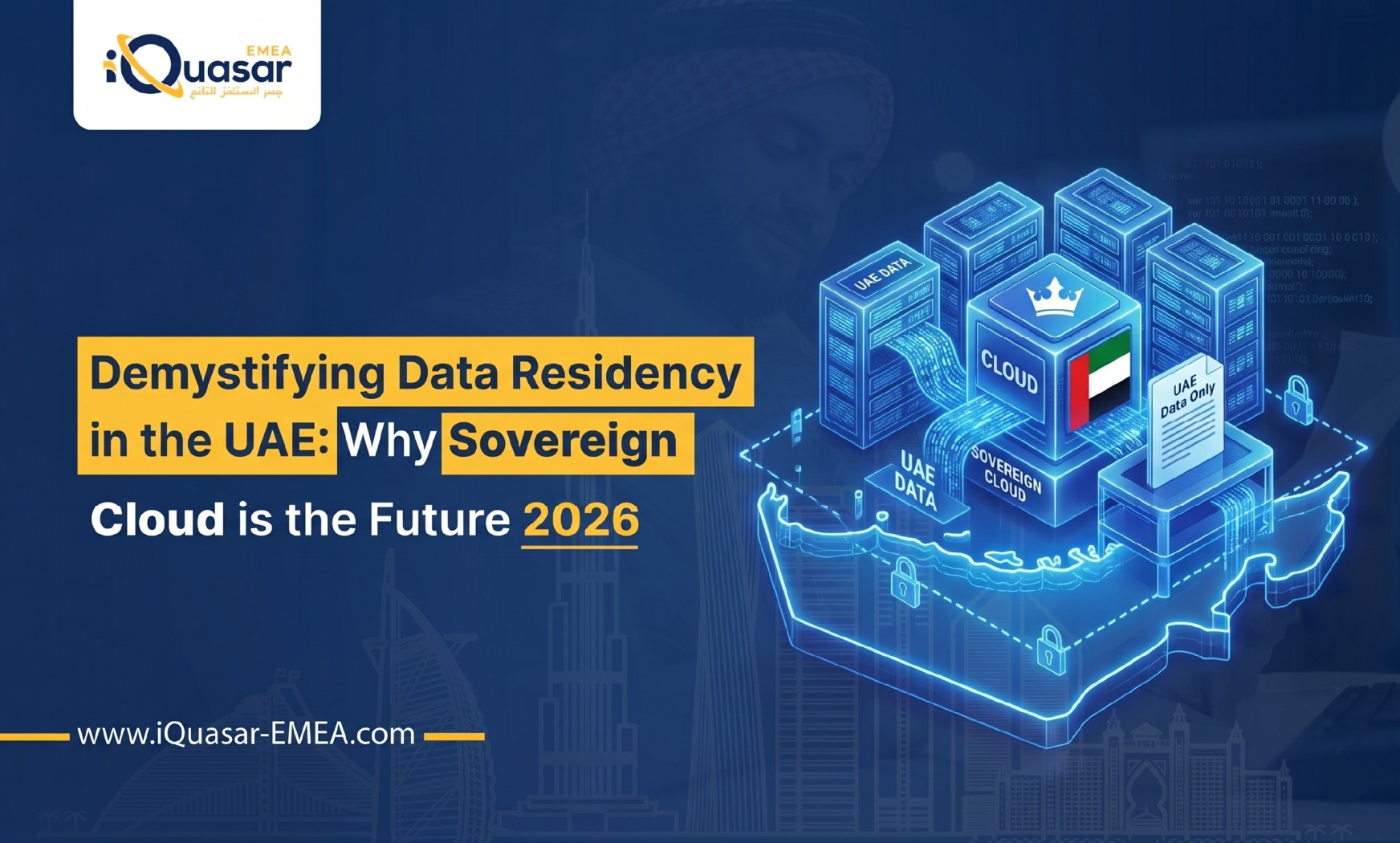
Sovereign cloud is a cloud model in which all data storage, processing, and management occur within a defined national jurisdiction, under that jurisdiction’s governance and legal authority. Unlike simply using a provider’s regional data center, sovereign cloud ensures that data never leaves approved boundaries, that compliance is built into the architecture rather than bolted on, that in-country performance is optimized by design, and that operational management is handled by local personnel under local law. This eliminates the compliance-versus-performance trade-off that undermines conventional cloud strategies.
Why Sovereign Cloud Is the Future of Cloud in the UAE
The shift is already underway. du’s National Hypercloud, launched in July 2025, became the region’s first sovereign hypercloud. Oracle expanded its Abu Dhabi region in November 2025 with the Middle East’s first OCI Supercluster, over 4,000 NVIDIA Blackwell GPUs supporting sovereign AI. The UAE Sovereign Launchpad is contributing to the broader digital economy growth projected to unlock USD 181 billion in cumulative value by 2033 through accelerated cloud adoption.
According to Fortune Business Insights, the MEA sovereign cloud market reached USD 11.36 billion in 2025 and is projected to hit USD 13.55 billion in 2026. The global market is forecast to grow at a 24.6% CAGR, reaching USD 1,133.3 billion by 2034. Adoption is concentrated in banking, government, healthcare, and critical infrastructure, the exact sectors where UAE localization rules are strictest. The question for enterprise leaders is no longer whether to adopt sovereign cloud, but how quickly.
FAQs: Data Residency & Sovereign Cloud in the UAE
- What is data residency in the UAE?
Data residency refers to requirements that personal, financial, healthcare, or government data be stored and processed within the UAE borders. Specifics vary by sector, with banking, healthcare, and government data subject to the strictest mandates.
- Is sovereign cloud mandatory in the UAE?
Not universally, but it is effectively required for regulated sectors. The Central Bank’s 2026 sovereign financial cloud and the UAE Sovereign Launchpad signal a clear trajectory toward sovereign cloud as the compliance standard.
- How does UAE PDPL impact cloud storage?
The PDPL requires cross-border transfers to meet adequacy standards or have contractual safeguards. Organizations must ensure cloud-stored personal data complies with data minimization, purpose limitation, and security requirements. Non-compliance risks a fine of up to AED 5 million.
- Can companies store data outside the UAE?
Under the PDPL, transfers are permitted provided adequate safeguards are in place. However, banking data must remain in-country per Central Bank rules, and healthcare data may not leave the country except with special authorization. Government-classified data must stay within the UAE at all times.
- What industries require strict data localization?
Banking and financial services, healthcare, government and public sector, electronic payment processing, and telecommunications/critical infrastructure face the strictest localization requirements.
Preparing for a Sovereign Cloud-First Future
The UAE’s data residency landscape has moved from regulatory ambiguity to decisive action. The PDPL provides the federal framework, sector-specific mandates set binding localization requirements, and government-backed initiatives are building infrastructure to make compliance operationally feasible at scale.
Cloud strategies must now be designed around data residency at the architecture level. Organizations that audit their data flows, evaluate sovereign cloud readiness, and engage partners with proven regional expertise will maintain compliance, retain eligibility for government contracts, and build infrastructure that supports growth in one of the world’s most dynamic markets.
iQuasar EMEA, based in Dubai Silicon Oasis, combines cloud infrastructure expertise, cybersecurity capabilities, and deep familiarity with UAE regulations to help enterprises architect compliant cloud environments. Their cloud solutions are designed from the ground up to meet data residency requirements, ensuring alignment with PDPL mandates, Central Bank standards, and sector-specific rules before workloads are migrated.
To explore how your organization can transition to a compliant sovereign cloud architecture, connect with iQuasar EMEA’s cloud and digital transformation experts for a consultation tailored to your regulatory and operational requirements.