Cybersecurity Solutions Dubai: Why Traditional Perimeter Defense No Longer Fits
For two decades, enterprise security architecture rested on a simple premise: build a strong enough wall around the network, and threats stay outside. Firewalls, VPNs, and network segmentation defined the perimeter, and everything inside that perimeter was implicitly trusted. For boards and CISOs evaluating Cybersecurity Solutions Dubai enterprises now depend on, that premise is fast becoming a liability rather than a safeguard.
This is not a technical footnote. It is a governance and risk issue that belongs on the executive agenda, because the assumptions underpinning perimeter defense have been invalidated by how Dubai enterprises actually operate today. Distributed workforces, multi cloud estates, third party integrations, and regulatory frameworks now assume continuous verification, not a one time gate check.
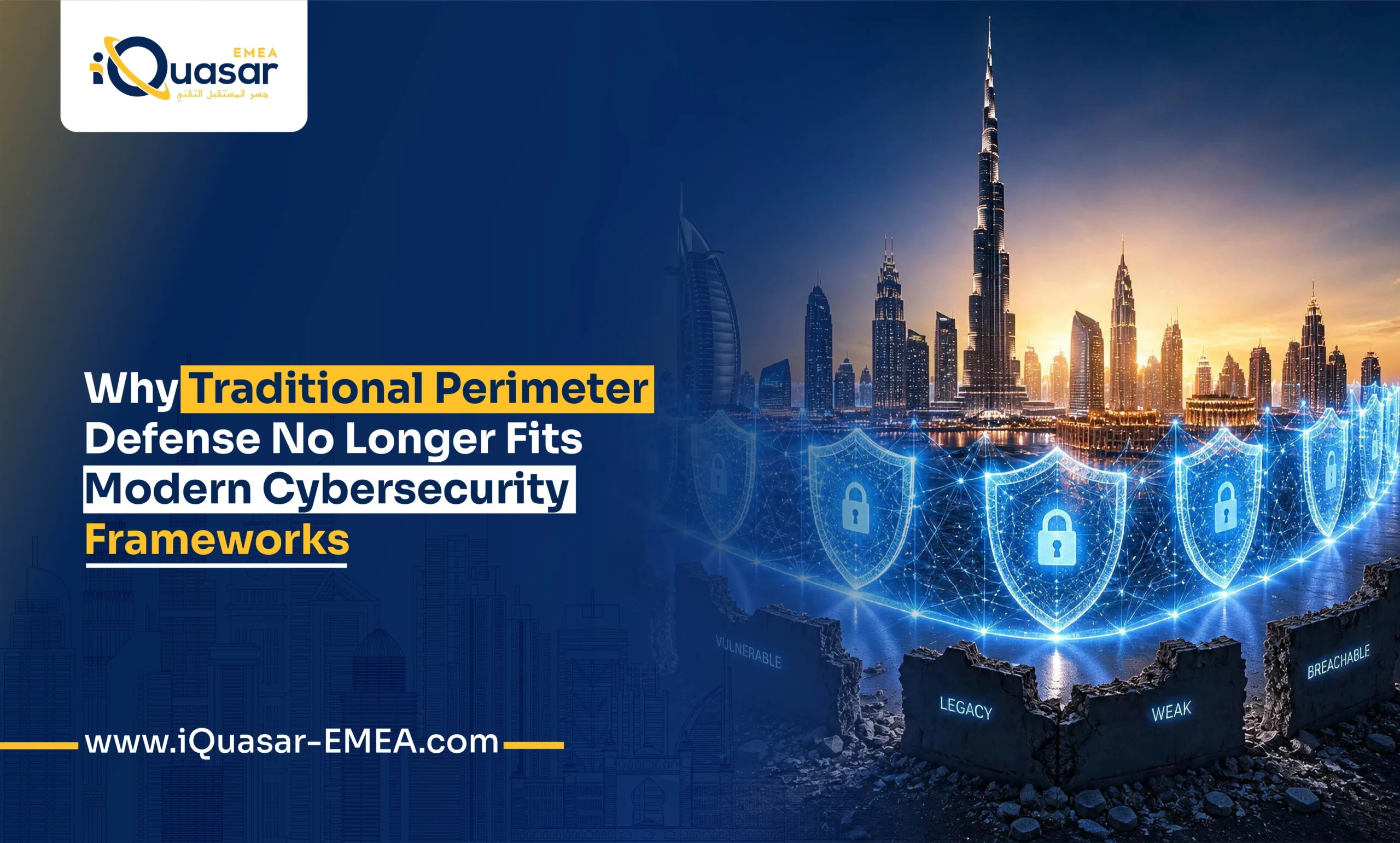
The Perimeter Was Built for a Network That No Longer Exists
Perimeter defense assumes a bounded, knowable network edge. That assumption held when applications lived in a single data center and employees connected from a single office. In Dubai’s current business environment, none of that is true:
- Workforces are distributed. Hybrid work, contractors, and regional teams across the GCC connect from outside any defined boundary.
- Infrastructure is multi cloud. Azure, AWS, and on premises ERP systems coexist, each with its own access surface.
- Ecosystems are interconnected. Vendors, logistics partners, and fintech integrations all require access paths that a perimeter model was never designed to govern.
- Identity, not location, is now the attack surface. Credential theft, not network intrusion, is the dominant path to compromise.
When the network has no edge, a defense model built entirely around the edge stops functioning as intended. Executives who continue to fund perimeter centric architecture are, in effect, protecting a boundary that attackers have already learned to walk around.
3 Reasons Perimeter Models Fail Modern Cybersecurity Solutions for Dubai
1. Regulatory frameworks now assume Zero Trust, not implicit trust. UAE aligned compliance expectations, including ISO 27001 alignment, sector specific mandates, and Dubai’s broader Smart Government and Digital Dubai direction, increasingly expect continuous verification, least privilege access, and auditable identity controls. A castle and moat model cannot produce the granular access logs and control evidence these frameworks require. Compliance gaps translate directly into regulatory and reputational exposure at the board level.
2. Lateral movement, not perimeter breach, is the real risk. Once a single credential or endpoint is compromised, a flat internal network lets attackers move freely toward the systems that matter, including financial platforms, ERP, and customer data. Perimeter defense has nothing left to say once the attacker is “inside,” because inside was always treated as safe.
3. Cloud and SaaS adoption bypass the perimeter entirely. Dubai enterprises accelerating cloud migration and Microsoft ecosystem adoption are moving critical workloads to environments the traditional perimeter was never built to see, let alone control. Security teams end up defending an increasingly irrelevant boundary while the actual estate lives elsewhere.
What Modern Cybersecurity Solutions Require Instead
The shift executives need to sponsor is not a product purchase. It is an architectural and governance shift, built around:
- Zero Trust identity verification. Every access request authenticated and authorized regardless of network location.
- Micro segmentation. Limiting lateral movement so a single compromised credential cannot cascade across the environment.
- Continuous monitoring and SOC visibility. 24×7 detection across cloud, on premises, and hybrid infrastructure, not just the network edge.
- Compliance mapped controls. Security architecture that produces the audit trail regulators and boards now expect.
- Executive level security governance. Strategic ownership of risk posture, not just technical patching, often delivered through a vCISO model where a full-time hire isn’t yet justified.
This is a reallocation of security investment. It moves funding away from static boundary hardening and toward identity, visibility, and governance that scale with a distributed, cloud first enterprise.
The Board Level Takeaway
Perimeter defense is not obsolete because the technology aged. It is obsolete because the operating model it was designed to protect no longer exists in most Dubai enterprises. Continuing to invest primarily in perimeter controls creates a false sense of security while the real exposure, identity compromise, lateral movement, and unmonitored cloud sprawl, goes largely unaddressed. For executives, the question is no longer “is our firewall strong enough,” but “can we verify and monitor every access request, everywhere, at all times.” That is the standard modern cybersecurity solutions Dubai frameworks are now built around, and it is the standard regulators, boards, and customers increasingly expect.
How iQuasar EMEA Delivers Cybersecurity Solutions Dubai Enterprises Need
Rebuilding a security architecture around identity, continuous monitoring, and compliance takes a partner who understands both the technical shift and the regulatory realities of operating in the UAE. iQuasar EMEA, FZCO, based in Dubai Silicon Oasis, works with organizations on exactly this transition, offering remote SOC and 24×7 monitoring, Virtual CISO (vCISO) support, incident response, and compliance assessments aligned to ISO 27001, NCA, ADHICS, and other regional frameworks, backed by over two decades of enterprise security experience.
For organizations still weighing what a modern, Zero Trust aligned posture would look like, iQuasar EMEA is a good place to start that conversation.