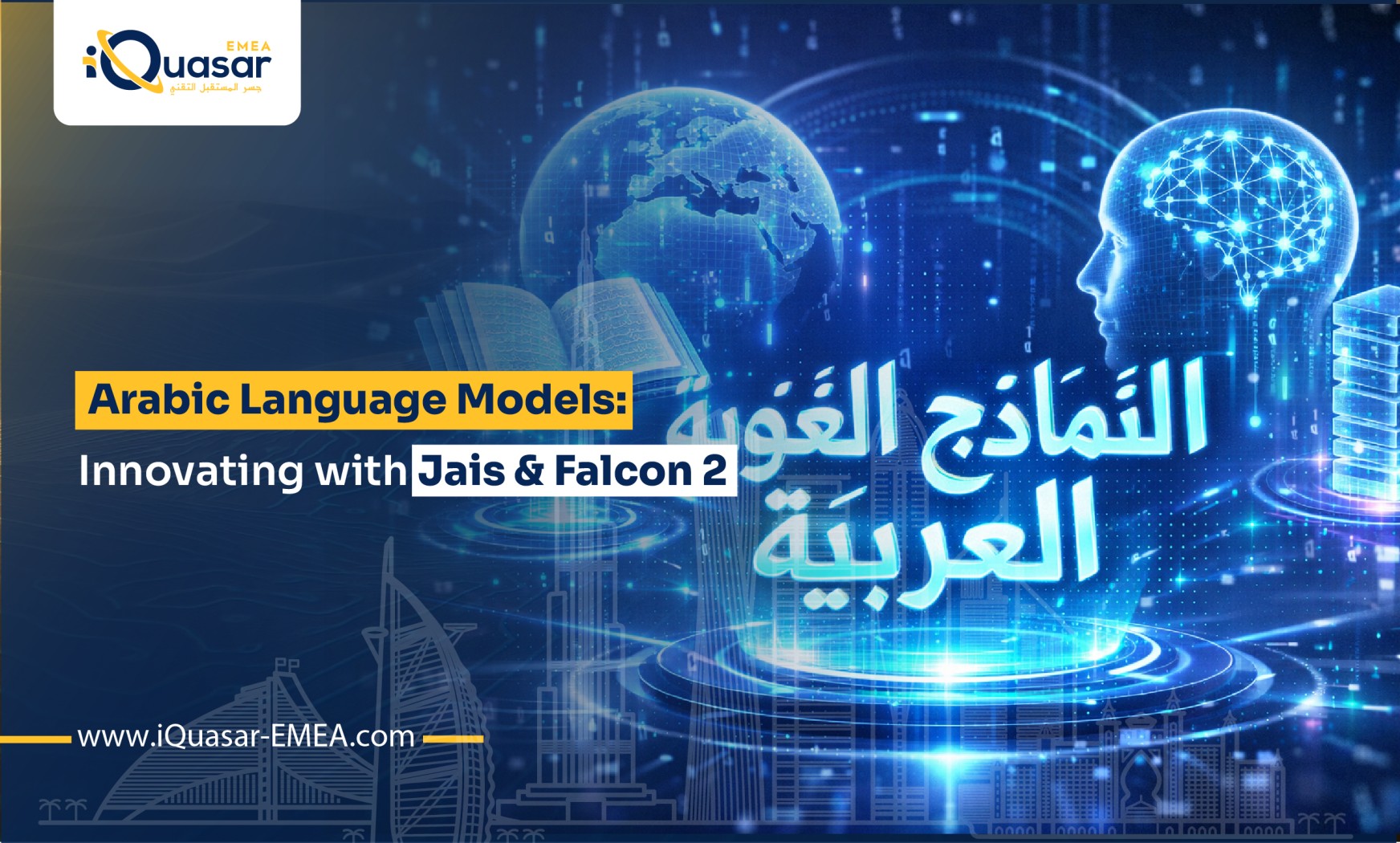
Arabic Language Models: Innovating with Jais & Falcon 2
In GCC boardrooms, even a small language or dialect mismatch can undermine a generative AI initiative. Enterprises increasingly recognize that successful AI adoption in the Middle East requires more than global large language models. It requires Arabic language models that understand local dialects, cultural context, and regulatory expectations.
In 2026, Arabic-first AI is becoming a strategic requirement for enterprises operating across government, finance, healthcare, and public services in the region.
What Are Arabic Language Models?
Arabic language models are AI systems trained primarily on Arabic text to understand and generate Arabic with high linguistic accuracy. Unlike generic multilingual models, they are built to capture Arabic syntax, semantics, and pragmatic usage across both formal and conversational contexts.
In the GCC, this distinction is critical. Modern Standard Arabic (MSA) is used for official communication, regulation, and media, while dialectal Arabic dominates customer interactions and everyday communication. Enterprise-grade Arabic language models must perform reliably across both.
Strong Arabic models go beyond translation. They preserve meaning, tone, and cultural nuance, which is essential for trust, compliance, and adoption.
Why Global LLMs Fall Short for Arabic Enterprises
Many global LLMs struggle with Arabic enterprise use cases due to limited dialect coverage, weak cultural grounding, and generic compliance assumptions.
Common challenges include inaccurate interpretation of region-specific terms, misalignment with regulatory language, and outputs that feel unnatural to native speakers. For regulated sectors, these gaps introduce compliance risk and slow adoption.
As enterprises move from pilots to production, these limitations become operational blockers rather than minor inconveniences.
Jais 2 and Falcon -H1 Arabic: Enterprise-Ready Arabic Language Models
A new generation of Arabic-first models is addressing these gaps.
Jais 2 is a regionally tuned Arabic language model with 70 billion parameters, trained on the largest Arabic-first dataset ever assembled, including 17 regional dialects and Modern Standard Arabic. It emphasizes linguistic fidelity, regulatory phrasing, and enterprise governance, making it well-suited for customer-facing applications, internal knowledge systems, and public-sector workloads.
Falcon-H1 Arabic extends the Falcon model family with enhanced Arabic capabilities through a hybrid Mamba-Transformer architecture, available in 3B, 7B, and 34B parameter sizes, with context windows up to 256K tokens. It enables faster domain fine-tuning, improved factual accuracy in Arabic responses, and stronger alignment with GCC data governance and security requirements.
Both models support enterprise deployment patterns, including regional hosting, auditable outputs, and controlled fine-tuning, which are essential for responsible GenAI adoption in the Middle East.
How Enterprises Use Arabic LLMs in Practice
Localization Beyond Translation
Arabic LLMs enable enterprises to localize content accurately rather than relying on literal translation. This includes embedding official terminology, aligning with regional date and currency formats, and producing culturally natural phrasing that builds user trust.
Domain-Specific Fine-Tuning
Enterprises fine-tune Arabic models on sector-specific data such as financial regulations, procurement policies, or healthcare guidelines. This allows AI systems to generate responses aligned with local laws, procedures, and compliance standards.
Cultural and Contextual Accuracy
Well-governed Arabic LLMs respect local etiquette, data privacy norms, and public-sector communication standards. Outputs are validated against bilingual regulatory texts to reduce misinterpretation and risk.
Key Enterprise Use Cases in the GCC
Arabic language models are already delivering value across multiple domains:
- Customer service: Dialect-aware chatbots and Arabic knowledge search that improve resolution rates
- Internal knowledge systems: Arabic document search, summarization, and policy generation
- Compliance and reporting: Arabic regulatory documentation with traceability and audit support
- Public sector services: Citizen-facing portals with secure, Arabic-first AI interactions
Arabic LLMs vs Global LLMs for Enterprise AI
Arabic-focused models such as Jais 2 and Falcon-H1 Arabic provide stronger dialect accuracy, better cultural alignment, and greater flexibility for GCC compliance needs. Global LLMs often require extensive customization and still struggle with regional nuance and regulatory language.
For enterprises prioritizing trust, explainability, and data sovereignty, Arabic LLMs offer a clearer path to production.
Table: Arabic LLMs vs Global LLMs for Enterprise Use
| Aspect | Arabic LLMs (e.g., Jais 2, Falcon -H1 Arabic) | Global LLMs |
| Language fidelity in dialects | High with local data and governance | Variable: dialect gaps may appear |
| Compliance readiness | Tailorable to GCC laws and standards | Often generic or locale-agnostic |
| Deployment options | On-prem and regionally hosted options | Primarily cloud-focused; mixed on-prem options are slower |
| Cultural alignment | Strong regional etiquette and context | Varies, risk of misalignment |
| Customization velocity | Faster fine-tuning for domain needs | Longer cycles for domain alignment |
Moving from Pilots to Scaled Arabic GenAI
Successful organizations define clear regional use cases, roll out Arabic AI in phases, and invest early in governance and data controls. High-impact domains such as customer service and compliance documentation often deliver the fastest returns. Enterprises looking to move beyond experimentation benefit from structured AI integration frameworks that align language models, processes, and governance. Arabic language models are becoming a foundational capability for enterprise AI in the GCC. By leveraging regionally aligned models such as Jais 2 and Falcon-H1 Arabic, organizations can deploy generative AI that reflects local language, culture, and regulatory realities.
With the right governance, data strategy, and execution model, Arabic GenAI evolves from experimentation into a trusted enterprise asset. If your organization is evaluating how to deploy generative AI that truly understands the Arabic language and context, our team at iQuasar EMEA can help you assess options, design responsible architectures, and build scalable solutions aligned to regional needs.
Contact us to discuss your next Arabic enterprise AI strategy: https://iquasar-emea.com/contact