The Role of Artificial Intelligence in Powering the UAE’s Smart City Initiatives
When Abu Dhabi committed $3.5 billion to become the world’s first AI-native government by 2027, it sent an unmistakable signal to every enterprise operating in the Gulf: artificial intelligence is no longer a competitive advantage; it is the price of entry.
Across the UAE, AI is being woven into the fabric of daily urban life. Traffic lights in Dubai adjust themselves in real time. Government permits in Abu Dhabi are issued automatically before residents even apply. Energy grids across Masdar City predict consumption spikes hours before they happen. These are not prototypes sitting in innovation labs. They are live systems running at city scale, backed by national budgets, regulatory mandates, and aggressive timelines.
For CIOs, CTOs, and digital transformation leaders in the GCC, the strategic question has shifted. It is no longer “Should we invest in AI?” but “Do we have the architecture, the partners, and the compliance posture to participate in the largest smart city build-out in history?”
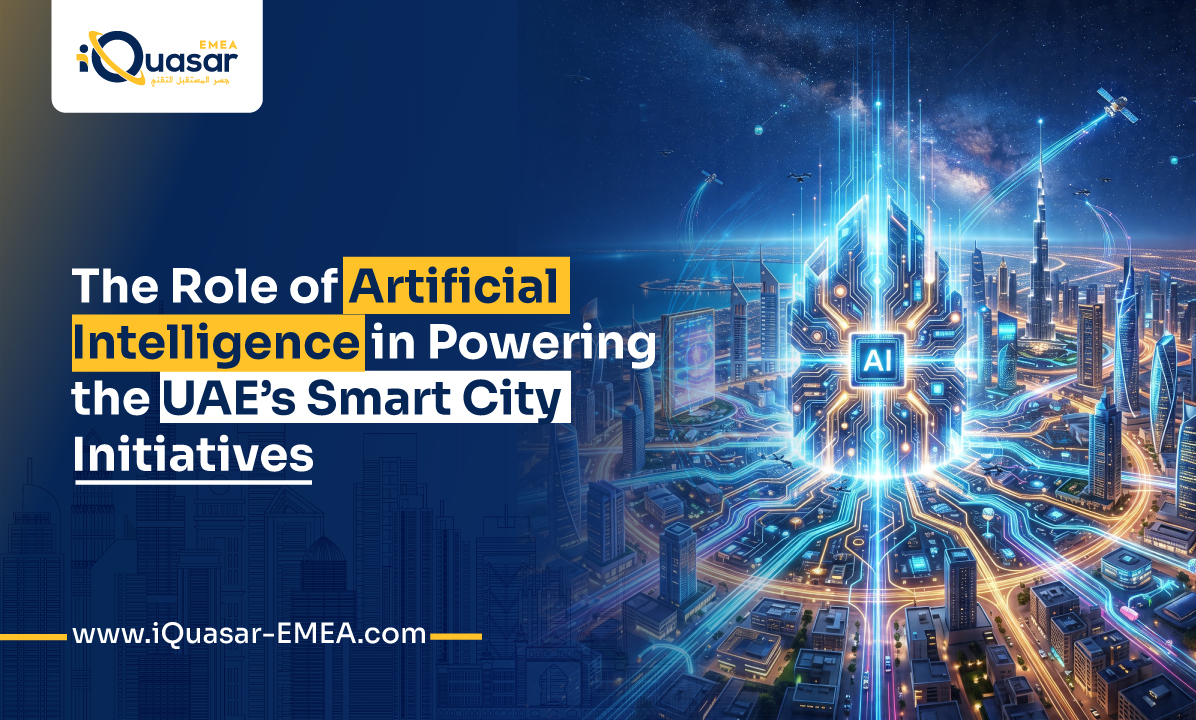
What Is a Smart City, and Why Has the UAE Become Its Global Standard-Bearer?
A smart city is an urban environment that uses interconnected technologies, artificial intelligence, IoT sensors, cloud computing, and big data analytics to make infrastructure responsive, services predictive, and governance data-driven. The distinction from traditional urban planning is fundamental: smart cities do not react to problems. They anticipate and prevent them.
The UAE has emerged as the world’s most aggressive adopter of this model. The UAE National AI Strategy 2031 maps AI integration across nine sectors with the explicit aim of positioning the country among the top ten global AI leaders. Digital Dubai runs its smart city program across six pillars: economy, governance, mobility, environment, living, and people. Abu Dhabi’s Government Digital Strategy 2025–2027 is channeling billions into AI-native public services, sovereign cloud migration, and the development of 200 new AI solutions for government use.
The scale is staggering. The GCC smart cities market reached USD 19.2 billion in 2025 and is projected to hit USD 69 billion by 2034 (IMARC Group). The broader GCC smart cities and digital transformation market stood at approximately USD 145 billion in 2024, with DataM Intelligence projecting it to reach USD 907 billion by 2032.
Why this matters for enterprise leaders: These are not aspirational figures. They represent active procurement pipelines, government tenders, and public-private partnership frameworks that favor organizations with demonstrated AI delivery capabilities and regional compliance credentials.
How Is AI Reshaping Urban Infrastructure Across the UAE?
AI in the UAE is not a bolt-on to existing city systems. It is the operational backbone — the decision layer — running beneath transportation networks, energy grids, government platforms, and public safety systems.
1. Intelligent Transportation and Autonomous Mobility
Dubai’s Roads and Transport Authority (RTA) operates one of the most advanced AI-powered traffic ecosystems in the world. Thousands of sensors feed real-time data into machine learning models that dynamically adjust signal timing, reroute vehicles, and predict congestion before it forms. The Dubai Autonomous Transportation Strategy aims to have 25% of all journeys be fully autonomous by 2030. Self-driving taxis are already in testing. RTA’s own AI Strategy 2030 spans 81 projects across six operational pillars.
The result: AI-driven traffic management has already reduced congestion in key Dubai corridors by an estimated 25%.
The enterprise implication: Any organization building transportation technology for the UAE market must design for real-time analytics, edge computing integration, and seamless interoperability with RTA’s AI-driven ecosystem. This demands advanced software engineering and robust cybersecurity architecture working in tandem.
2. Energy Management and Sustainability
The UAE’s Net Zero 2050 initiative depends on AI to make energy systems intelligent. Masdar City in Abu Dhabi functions as the world’s most visible testbed for AI-driven sustainable urban design, using predictive analytics to manage smart grids, regulate building-level energy consumption, and reduce carbon output across an entire urban district. The Mohammed bin Rashid Solar Park, set to become one of the largest single-site solar installations globally, relies on AI-powered predictive maintenance and output optimization systems.
The enterprise implication: Energy sector organizations need AI platforms that can process massive, continuous sensor data streams while meeting evolving sustainability reporting requirements; a use case that demands scalable cloud infrastructure built for both performance and compliance.
3. Public Safety and Smart Governance
Dubai Police use AI-driven facial recognition, predictive analytics, and anomaly detection to strengthen public security. The city’s Zero Bureaucracy Initiative has streamlined government service processes from 12 steps to 1 or 2. More than 99% of government services are now available online, saving over 300 million paper transactions annually. Abu Dhabi’s TAMM 4.0 platform delivers over 800 government services through proactive intelligence, reducing manual government visits by more than 90%.
The enterprise implication: Public sector technology providers must deliver AI solutions that balance predictive service delivery with rigorous citizen data protection, demanding both advanced machine learning capabilities and compliance-first cloud architectures.
4. Healthcare and Precision Medicine
AI is accelerating clinical capabilities across UAE hospitals. Machine learning models analyze medical imaging, patient histories, and population health datasets to support early detection and personalized treatment planning. Telemedicine platforms integrated with AI-driven diagnostics are expanding healthcare access across the Emirates.
The enterprise implication: Healthcare IT providers need cloud environments that meet strict data sovereignty requirements under the UAE’s sector-specific regulations while supporting the low-latency processing required by clinical AI.
What National Strategies Are Driving the UAE’s AI-First Agenda?
The UAE’s smart city transformation is being orchestrated through a layered framework of national strategies, each with defined budgets, timelines, and accountability structures.
- UAE National AI Strategy 2031: Eight strategic objectives targeting global AI leadership, from innovation centers and the 1 million AI Talents program, to sovereign data ecosystems and AI governance across every sector. AI is expected to contribute USD 96 billion to the UAE economy by 2031.
- Dubai Universal Blueprint for AI: Targeting AED 100 billion in annual economic productivity gains through AI adoption. Dubai is training AI leads across every government department, issuing commercial AI licenses, and integrating AI into school curricula.
- Abu Dhabi Government Digital Strategy 2025–2027: Backed by AED 13 billion (USD 3.5 billion), focusing on full automation of government services, 200 AI solutions, sovereign cloud migration, and the AI for All training program. Goal: the world’s first AI-native government by 2027.
- Dubai AI Seal (January 2025): A formal trust framework establishing certification standards for AI providers in the emirate, a clear regulatory signal that the government expects accountability alongside innovation.
Why this matters for CIOs: These strategies are procurement frameworks. They define which organizations get access to government contracts, public-private partnerships, and smart city project pipelines. Alignment is a structural advantage.
What Challenges Do Enterprises Face When Deploying AI in Smart City Ecosystems?
The opportunity is massive. So is the complexity. Enterprise leaders must navigate five interconnected challenges.
- Data Sovereignty and Regulatory Compliance: The UAE’s PDPL and sector-specific regulations impose strict rules on data storage, processing, and transfer. AI systems handling citizen data must operate within compliant, in-region infrastructure. Many global AI platforms default to overseas processing, creating an immediate compliance gap.
- Integration Across Heterogeneous Systems: Smart city ecosystems involve thousands of IoT endpoints, multiple clouds, legacy systems, and real-time pipelines. Connecting AI models to this infrastructure requires deep expertise in custom software integration and APIs.
- Cybersecurity at Critical Infrastructure Scale: When AI controls traffic signals and power grids, a security breach becomes a public safety event. End-to-end cybersecurity must be built into AI deployments from day one.
- Talent and Cross-Functional Readiness: AI deployment requires teams combining data science, cloud architecture, domain expertise, and regulatory knowledge. Many enterprises lack the internal bench strength.
- Cost and Infrastructure Investment: AI implementations in urban projects can exceed AED 500,000 per initiative, a barrier that demands the right technology partner to optimize architecture and cost.
FAQs: AI in Smart Cities — UAE and the GCC
Q: What role does AI play in UAE smart cities?
AI powers real-time traffic management, predictive energy optimization, automated government services, public safety analytics, and healthcare diagnostics across UAE’s smart city infrastructure.
Q: How much is the UAE investing in AI and smart city development?
Abu Dhabi alone has committed AED 13 billion ($3.5 billion), with AI projected to contribute USD 96 billion to the UAE economy by 2031.
Q: What is the UAE AI Strategy 2031?
A national framework with eight strategic objectives to make the UAE a global AI leader across innovation, talent development, data ecosystems, and governance.
Q: What challenges do enterprises face in deploying AI in UAE smart cities?
Data sovereignty compliance, integration across legacy and IoT systems, cybersecurity at infrastructure scale, talent gaps, and high deployment costs.
Q: Which UAE cities are leading AI-powered smart city development?
Dubai leads through its Smart City initiative and AI Blueprint, while Abu Dhabi is building the world’s first AI-native government by 2027.
Q: How can enterprises participate in UAE smart city projects?
They need compliant in-region infrastructure, proven AI capabilities, and a regional delivery partner aligned with national procurement frameworks.
Q: How does iQuasar EMEA support smart city AI initiatives?
iQuasar EMEA delivers end-to-end AI, cloud, cybersecurity, and digital transformation solutions from Dubai Silicon Oasis, purpose-built for UAE compliance and smart city delivery.
Preparing for the AI-Driven Urban Future: A Strategic Imperative
The UAE’s smart city ambitions represent more than an infrastructure upgrade. They represent a fundamental restructuring of how cities operate, how governments serve citizens, and how enterprises create value. With billions in committed investment, codified national AI strategies, and a regulatory environment that rewards early movers, the window for enterprises to position themselves within this ecosystem is narrowing. The organizations that will thrive are those that can deploy AI at scale, within compliant architectures, while maintaining the agility to adapt as regulations and technologies evolve. This demands more than off-the-shelf solutions; it demands a technology partner embedded in the region’s regulatory fabric and backed by global delivery experience.
iQuasar EMEA brings exactly this combination: AI expertise, secure cloud infrastructure, enterprise-grade cybersecurity, and digital transformation capabilities, all delivered from within the UAE, for the UAE.
Ready to align your technology strategy with the UAE’s smart city vision? Explore how iQuasar EMEA can accelerate your AI-driven transformation →